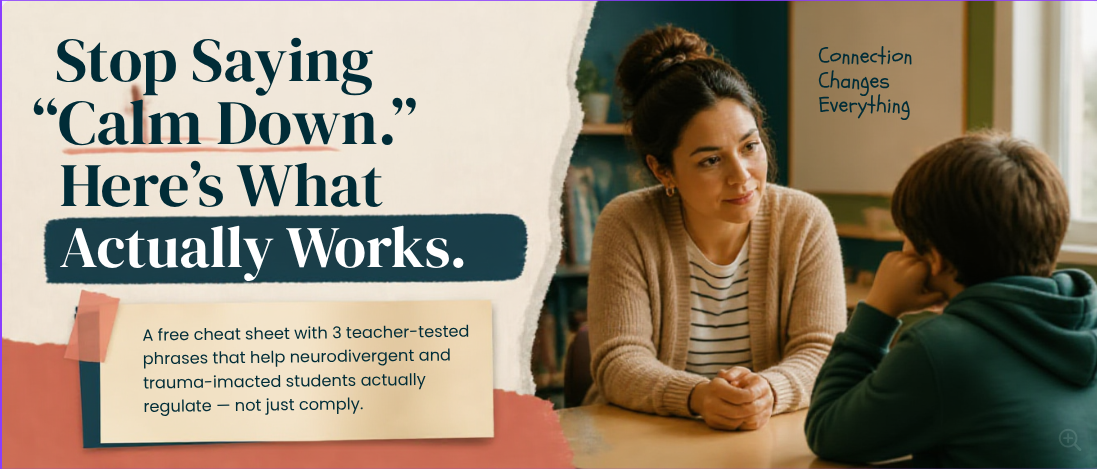
Stop Saying "Calm Down." Here's What Actually Works.
A free cheat sheet with 3 teacher-tested phrases that help neurodivergent and trauma-impacted students actually regulate — not just comply.
What's Inside:
3 exact phrases to swap in when a student is escalating
Why "calm down" backfires (the quick neuroscience behind it)
A simple script you can tape inside your desk or lesson planner
Stop guessing your classroom layout. Let's architect it for peace.
Don't spend the rest of your summer break panicking about a chaotic roster. Let a veteran teacher with two Master's degrees build a custom, neuroinclusive physical and behavioral blueprint for your specific room.

I know exactly what you're staring at right now...
It’s mid-summer, and the familiar knot in your stomach is starting to tighten. You’re looking at a blank grid sheet of your classroom, reading over heavy student IEPs, and wondering how you're going to survive the transitions, the blurting, and the behavioral crises without burning out by October.
Here is a reality check from an Educational Psychologist: A calm classroom doesn't happen because you bought matching pastel bins. It happens because you scaffolded the environment.
You don't have to figure this out in isolation. Let's build your plan together.
Meet Your Second Brain...
Hi, I’m Deanna. (Think of me as your highly credentialed, slightly chaotic teaching bestie)."
I have ADHD, I love hard, I have zero filter for corporate educational BS, and yes—I am a recovering perfectionist.
I also spent 12 years in the self-contained special ed trenches and hold two Master’s degrees: one in Elementary Education and one in Educational Psychology.
Because my own ADHD brain gets overwhelmed easily, I mathematically designed environmental frameworks that act as an external nervous system for the classroom. I know the neurobiology of why kids explode, and I know exactly how to arrange a room and script a transition to prevent it from happening.
©2026 All rights reserved.